Integrin αvβ6 – Trivehexin® and More
The cell surface protein αvβ6-integrin can be targeted with TRIMT’s proprietary cyclopeptide ligands.
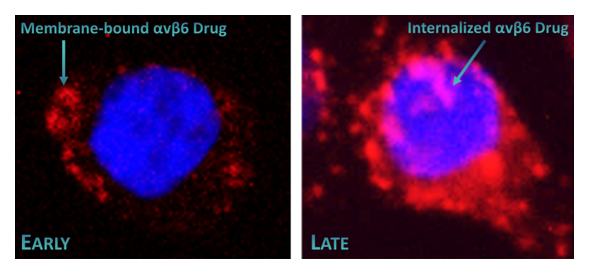
The protein-ligand complex is rapidly internalized into living cells (see Image), enabling delivery of various payloads to αvβ6-expressing organs or tissues, such as imaging reporters, drugs, or radionuclide warheads against cancer.
αvβ6 – The „Cancer Integrin“
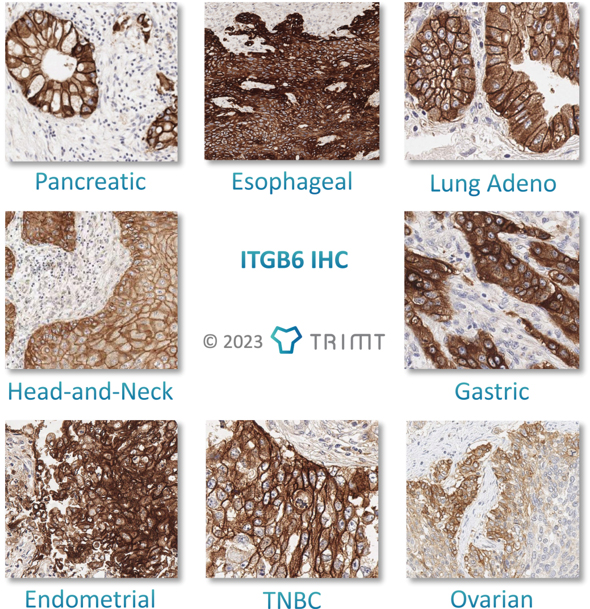
αvβ6-Integrin is expressed by a variety of carcinomas; hence its denomination as „Cancer Integrin“.[1] Among them are the most lethal cancer varieties, such as pancreatic ductal adenocarcinoma (PDAC; 88% of cases are αvβ6-positive).[2]
A high prevalence of αvβ6-integrin expression has furthermore been confirmed for other carcinomas, notably non-small-cell lung cancer (NSCLC; 97%), bladder cancer (TCC, 92%), esophageal adenocarcinoma (EAC, 99%), as well as the female cancers endometrial- (EC, 92%), ovarian- (OVCa, 88%), and triple-negative breast carcinoma (TNBC; 89%) (see Image).
αvβ6-Integrin recognizing therapeutics and radioligands have great potential to selectively target and kill the respective tumor cells, while sparing healthy cells. The ultimate goal is to develop more effective cancer therapies with fewer side effects to increase survival and quality of life for cancer patients.
[1] Quigley NQ, et al., Eur. J. Nucl. Med. Mol. Imaging 2022;49:1136.
[2] Steiger K, et al., Molecular Imaging 2017;16:1536012117709384.
68Ga-Trivehexin®
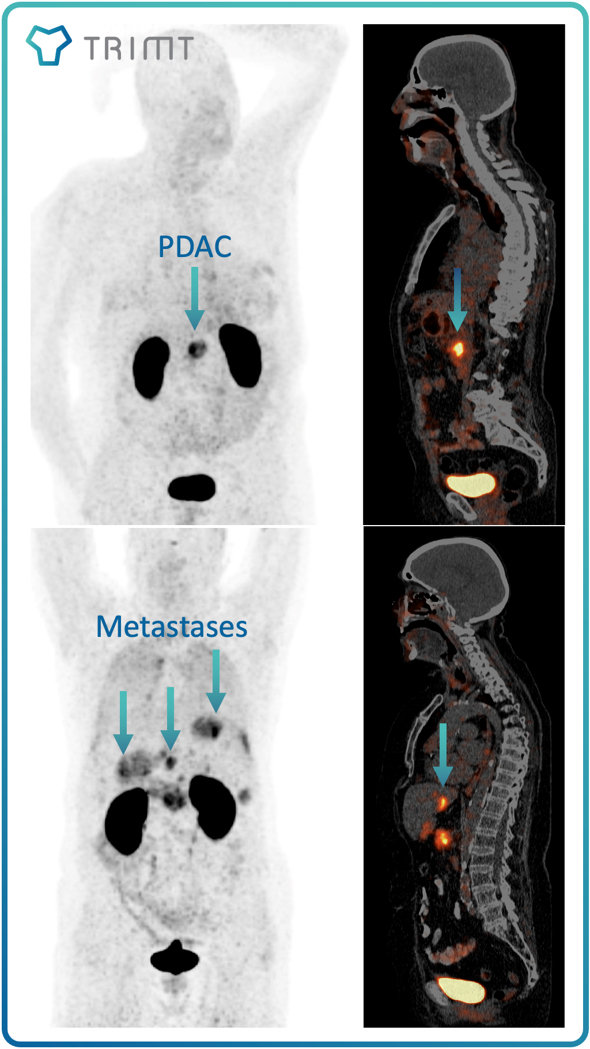
68Ga-Trivehexin® is a radiolabeled bioligand with high affinity for αvβ6-Integrin (a so-called tracer). It contains the short-lived medical isotope Gallium-68 (68Ga) for imaging with positron emission tomography (PET). Since many cancer cells display αvβ6-integrin on their surface, 68Ga-Trivehexin® enables visualization of these cancers by PET, for example, the highly aggressive pancreatic ductal adenocarcinoma (PDAC; see Image).[1,2]
αvβ6-Integrin is expressed by a wide variety of carcinomas and furthermore by fibrotic injuries of the lung, e.g., in the course of idiopathic pulmonary fibrosis (IPF) and COVID-19.[3] 68Ga-Trivehexin® thus also holds great promise for imaging of carcinomas as well as fibrosis and long-covid related pulmonary lesions.
68Ga-Trivehexin® is currently evaluated in clinical trials:
- US Phase 1[4] in healthy volunteers and PDAC
- IIT Phase 2[5] for comparison of 68Ga-Trivehexin® and [18F]FDG in PDAC and HNSCC
- in various special national programs for TNBC, PDAC, NHSCC, OVCa, and others.
[1] Quigley NQ, et al., Eur. J. Nucl. Med. Mol. Imaging 2021;48:4107.
[2] Quigley NQ, et al., Eur. J. Nucl. Med. Mol. Imaging 2022;49:1136.
[3] Kimura RH, et al., Am. J. Respir. Crit. Care. Med. 2023 207:1633.
[4] NCT05799274
[5] Thakral P, et al., Cancer Biother Radiopharm. 2023;38:468
177Lu-Therahexin
The clinical combination of radiopharmaceuticals for cancer imaging and therapy, frequently referred to as „Radio-Theranostics„, involves two steps (see Image):
- Diagnostics: Visualization of cancer lesions and selection of patients eligible for therapy by non-invasive imaging techniques such as positron emission tomography (PET).
- Radioligand Therapy (RLT): Targeted delivery of a radionuclide emitting alpha- or beta-radiation (i.e., energetic particles) to cancer cells, in order to eradicate the cancer lesions by irradiation from the inside.
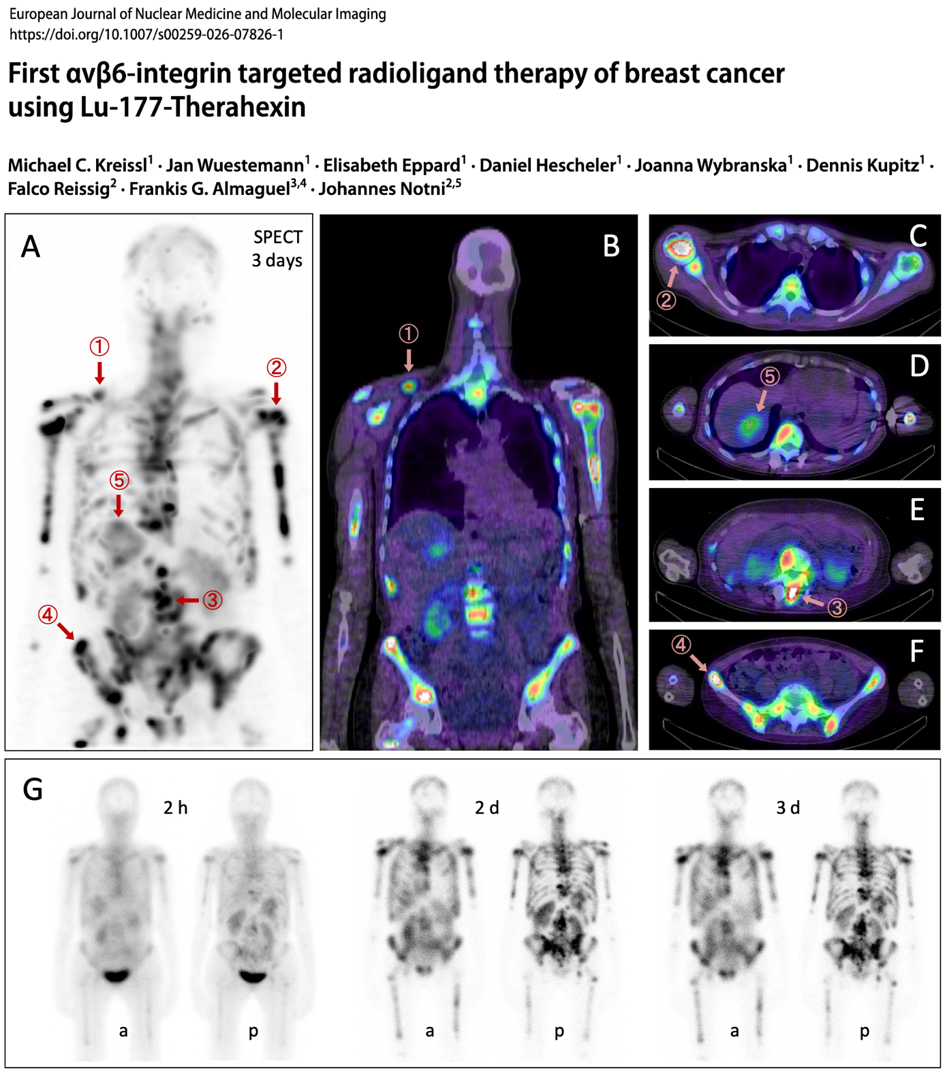
TRIMT’s 177Lu-Therahexin is the therapeutic counterpart of the PET imaging agent 68Ga-Trivehexin®. Together, they form a „Theranostic Pair“ of radiopharmaceuticals. 177Lu-Therahexin has been successfully applied for radioligand therapy of breast cancer[1] and pancreatic cancer.[2]
TRIMT is actively developing matched therapeutic radiopharmaceuticals to treat eligible cancer patients. Optimized drug candidates are currently prepared for clinical trials.
[1] Kreissl MC, et al., Eur. J. Nucl. Med. Mol. Imaging. 2026;53:4311.
[2] Wuestemann J, et al., Eur. J. Nucl. Med. Mol. Imaging. 2026;53:4304.
Molecular Imaging & Therapy
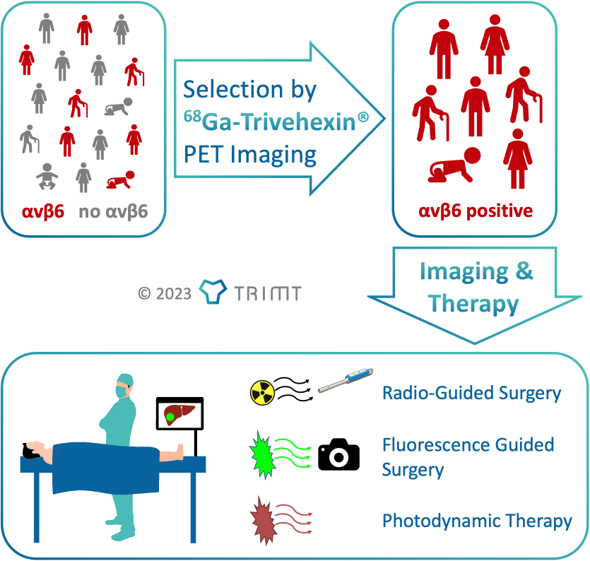
TRIMT’s proprietary αvβ6-integrin targeting cyclopeptides can be easily equipped with molecular units that interact with light. These so-called bioconjugates may comprise fluorescent dyes that can be detected with microscopes for cellular imaging. When such compounds are used during a surgical procedure and surgeons use intraoperative fluorescence camera devices that allow them to visually distinguish αvβ6-integrin expressing tumors from healthy tissue during surgery, this is called Fluorescence-Guided Surgery. In case the molecule contains a radioisotope that emits gamma-radiation and the intraoperative detection is done with a handheld gamma probe, the procedure is called Radio-Guided Surgery.
The light-sensitive part of the bioconjugate can also be a photocatalyst that releases cytotoxic substances (frequently, reactive oxygen species, ROS) when irradiated with light. In practice, such conjugates may be administered like the positron emission tomography (PET) tracer 68Ga-Trivehexin®. One they have reached their targets, i.e., the αvβ6-integrin expressing tumor cells, the entire tumor area can be irradiated with high-intensity laser beams to selectively eradicate the tumor while spare the surrounding normal tissue. This concept is widely referred to as Photodynamic Therapy.